

Development, RoP v4.42
Version 4.42 is now out on all platforms. This is a bugfix update, fixing some missing images, a couple crashes, and some unused items being in chests and the like in Chapter 2. There may be another patch next week depending on if there’s more bugs found, otherwise it’s full speed ahead on the next major update.
Version 4.42 (Mega.nz / Mediafire)
Fan Art
We got some good bits for you!

By Realmjork! It’s a shame Mei has to leave because I think she’d like dating Nadia.

By Kkst! This full-color image shows Maram being as cute and friendly as biology will allow. Look at that big smile!
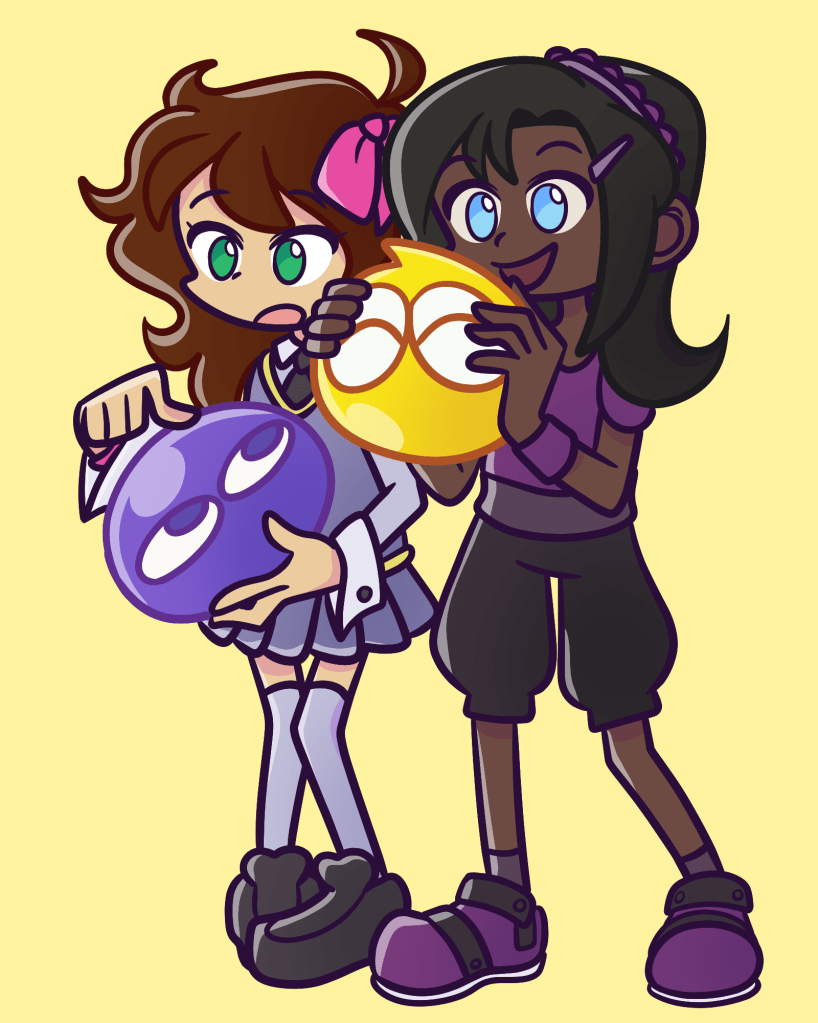
By Elly! I think that the power of love and combos might carry them through this. Would people play that? A TF game where if you lose at puyo-pop you turn into a doll?
No, right?
(Jessie just beats the shit out of you with the puyo pops and doesn’t play the game)
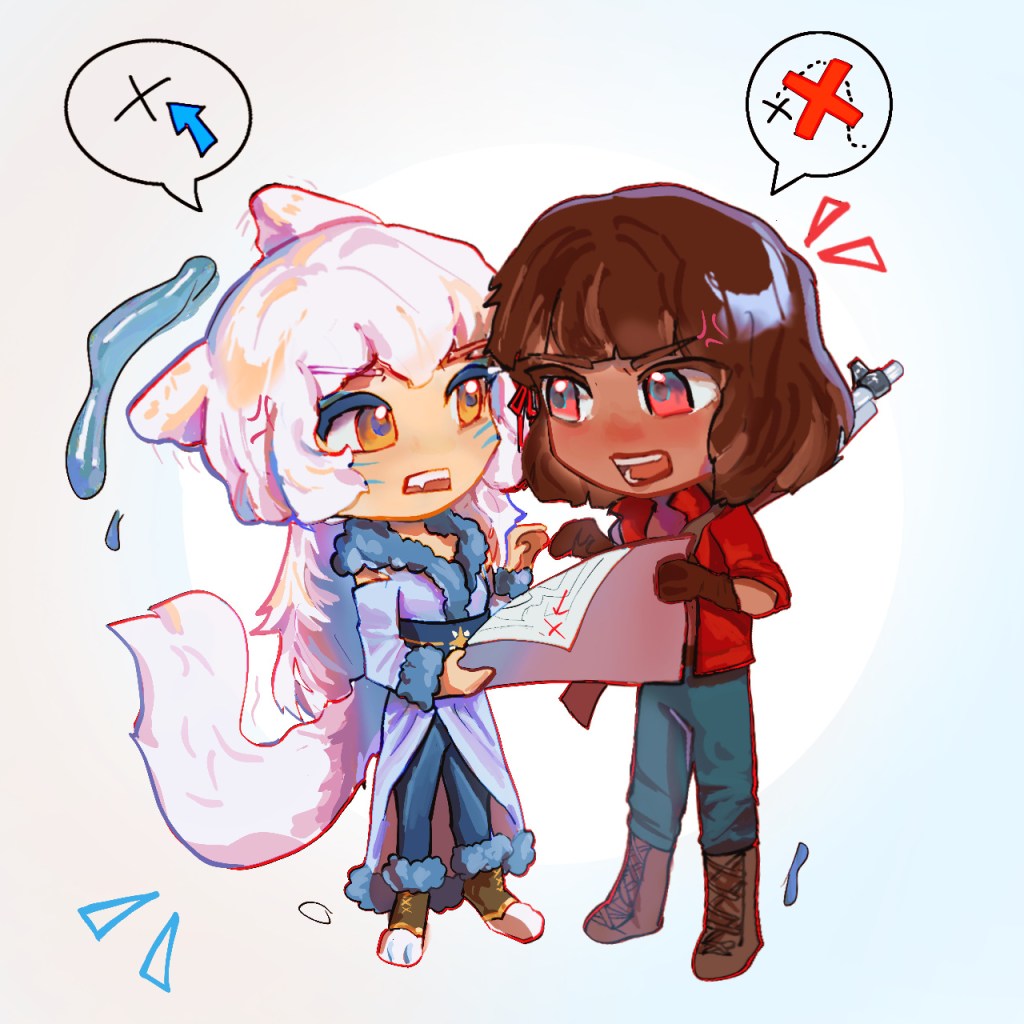
I love the prospect of Sanya, an alien from a different planet, arguing about directions with Izuna. Every single one of us knows someone who would do that and if you don’t, it’s you. By Shafaska.

By Eliuniverse. Here we see Maram, Mei’s training partner, practicing her “expressions” with Mei’s help. I’d say it’s going fairly well.

And the best for last, Mary as a Pegasus Knight by chey. I didn’t know Mario was into the Fire Emblem series but he made the :pwease: emote at me when I said we should make one. This won’t go well.
Mario I’m gonna turn people into like, doll knights and doll archers.
On The Subject of Mapping
I asked the Discord chat last week if they wanted to see a bit more about my mapping process. Some people like these little technical or design digressions, and I like writing about them. It’s fun! Maybe you’ll learn something (you will not) but you’ll also get a little preview about the upcoming Chapter 2 update.
So first, some setup. I try to make the maps fit together as much as possible, so as to preserve some amount of continuity when exploring. It’s important to note that the final maps often do not fit together, because of small changes that need to be made for gameplay reasons. This is particularly true of a lot of the stuff in chapter 5 where there is major overlap in the interior areas. Nothing you can do about that, gameplay is more important than playing map tetris.
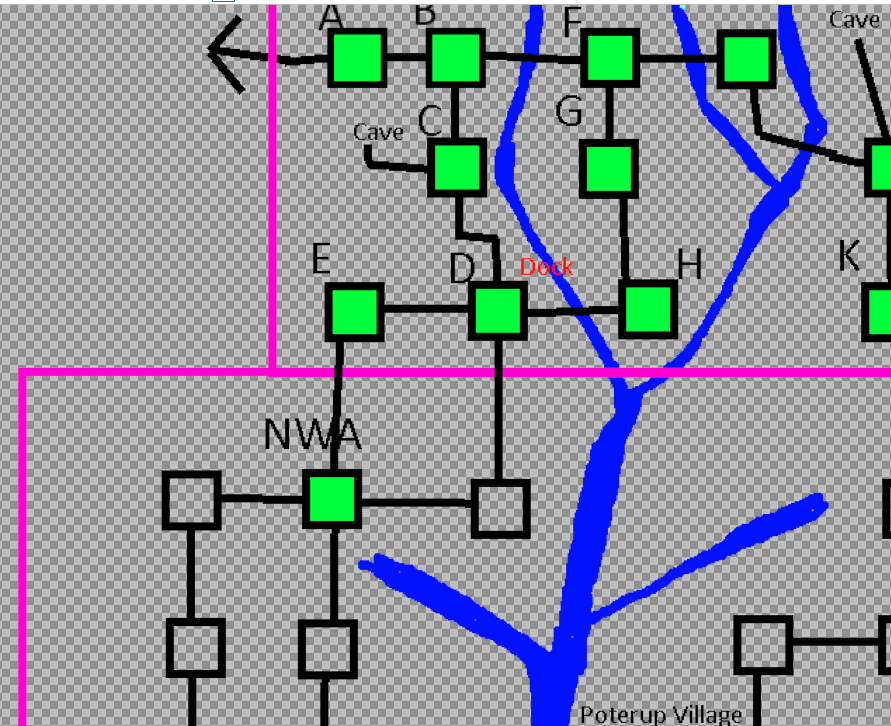
Maps are named by region, then with a letter indicating which is which. I have an image that tracks their spatial layouts, more or less. While rooms can technically be linked non-orthogonally, this is a 2D game and it’s much easier to have transition points at map edges.
On this image, rooms that are complete have a green box, and the name of the map written above it. In this case, we’re going to be making CapitolNWB (Old Capitol Grounds, Northwest, Room B) which connects to CapitolNWA and LitoreaD.

This is CapitolNWA. I try to make each major region have a unique visual identity, and the Old Capitol Grounds has two: the four types of trees, and later on, the Dragon Villa buildings. There’s no Dragon Villa buildings in this area, they become denser towards the southern parts of Old Capitol Grounds.

I have a 1:1 connectivity image that shows the maps. You can see LitoreaE and LitoreaD here. Litorea’s southern region looks a bit like Northwoods, but the northern part of Mount Litorea is the Red Jungles area. You can see how there are connection points, when they’re close I mark them with a red line, otherwise I put a little buffer on the edge, about 16 pixels. This can be adjusted if the room is resized.
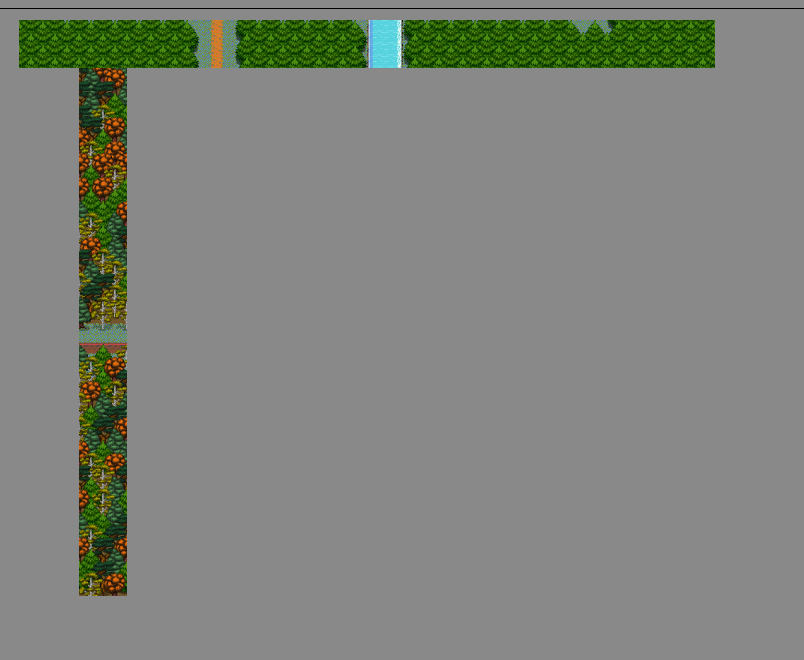
In order to make the edges contiguous, in Tiled I can copy blocks of tiles across to the new map, so here I’ve copied the right edge and south edges of the other maps. This means the river is the same distance from the path. I then move things around until the paths line up…

Here I’ve put a red rectangle around the room when overlaid, so the rooms should now be contiguous. In the final version of the room, typically the edge 2 or 3 tiles get cut off, they’re just there to make it easier to see.
Next we need to decide the map’s overall layout. This map is a section that shows how the river that runs through the Capitol Valley bisects the region, this is the northwestern most part of it. I want the player to be able to check out the river, maybe meet a fisherman, and have a few spots to put some treasure.

This is what the map looks like at first. Tiled has an automap function, so that’s what the oddly colored green tiles are. The path of the river is marked, and I have “edged” the map to define the walkable spaces.
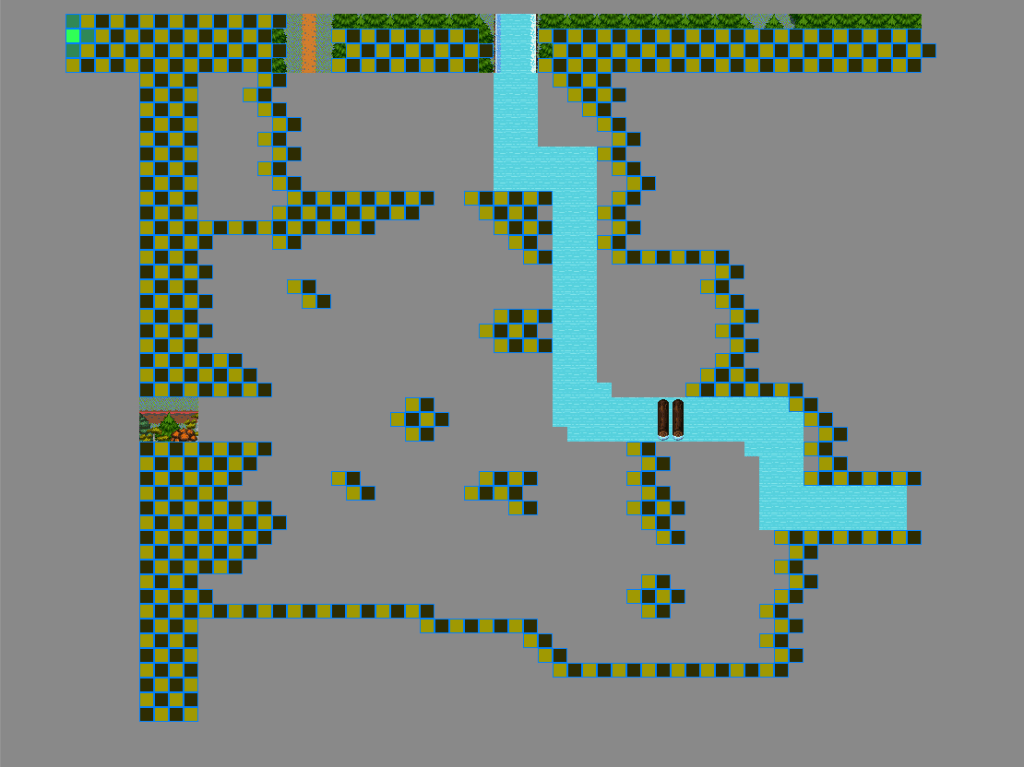
Running across big open empty fields isn’t very interesting, and also means enemies are extremely easy to avoid. You need to decide exactly where you want the “difficulty” of an area to be. Narrow corridors mean enemies have a distinct advantage as it’s harder to get around them, which is why I designed a lot of Westwoods to have narrow paths with enemy groups. Northwoods is more open. The Old Capitol Grounds are meant to have spots you can go to get around enemies, using alternate paths, so here I have blocks out some sight-blocking trees and also marked where I want the player to go to get across the river. The fisherman NPC is going to be there, away from the enemies, but you have to go around to get there, which makes exploring this area interesting.

Next, I block out the ground textures. The Old Capitol Grounds has brown soil under the forested sections, while Mount Litorea does not. This suggests something about the type of trees and soil fertility. In real life (at least where I live, the frozen north) heavily wooded sections tends to have more exposed soil and pioneer species while the scrubby forests and open areas are covered in grass. Okay now for some visual stuff.
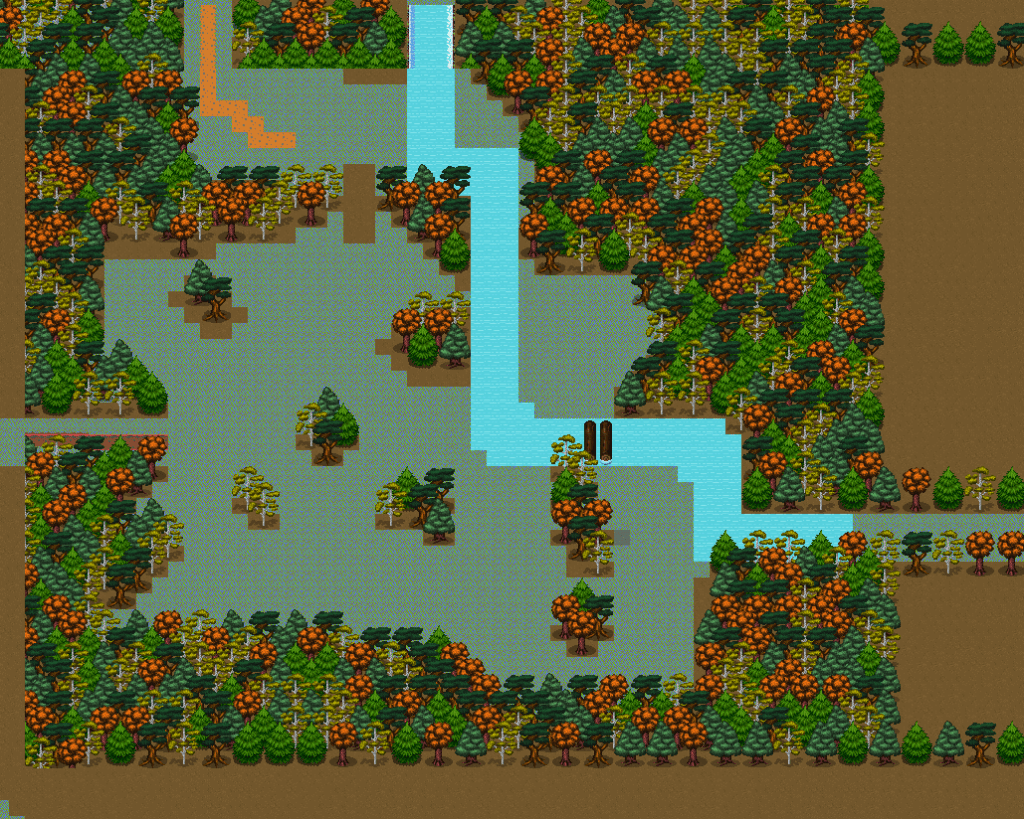
Tiled has an Automap function, which converts those squares on the RawTrees layer into actual trees on the Walls0/WallsHi0/WallsHi1 layers. It’s random which tree is selected, this is a thing the automap is capable of doing and I am using here. If I wanted, I could manually place trees but that’d take all day.
You will also note the paths that cut up the grass. These indicate to the player something important (exit points) and also catch their attention to lead them to interesting places. I’m going to add some to lead the player to the right side of the map as well. Next it’s time for detailing and to trim the edges off.

The ground’s first detailing pass, I turned the trees off to make it easier to see. This is the “fat” version of grass edges, which looks more organic. We’ll see the “thin” version around the water’s edge and the paths.
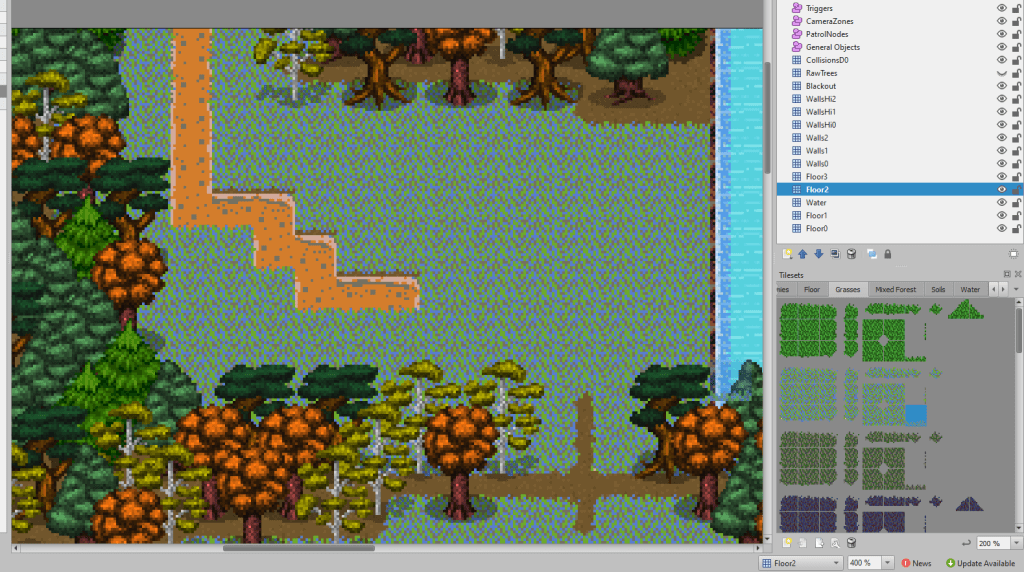
Thin edging involves putting an overlay so the grass looks like it’s growing close to the path on the south side, and a soil overlay on the grass on the north side so you can see bare soil where it touches the path.
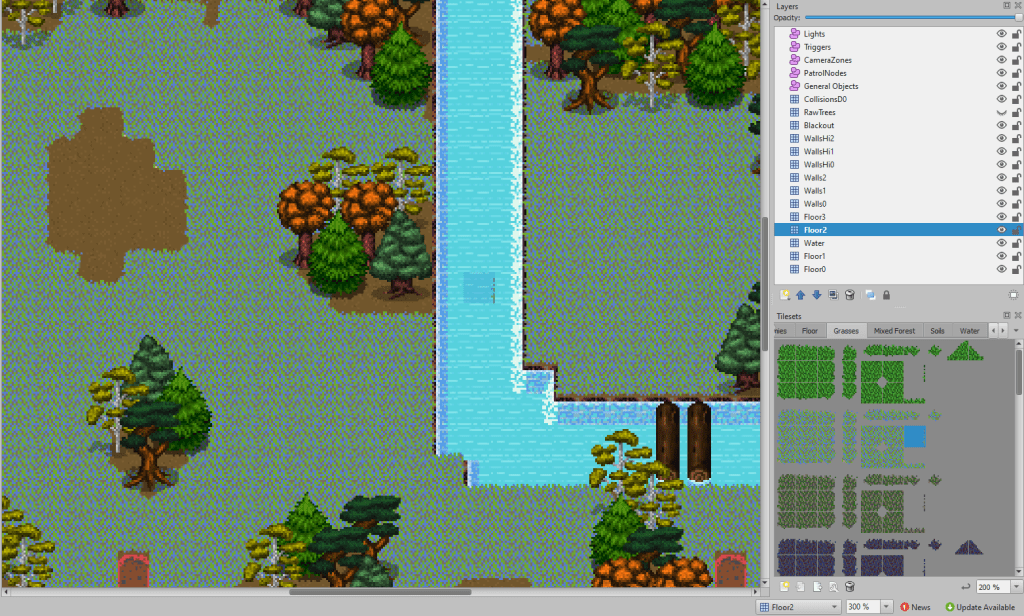
Next to the water, the thin edging. I also put a 1-2 pixel overlay tile on the west/east faces of river tiles to show the grass growing close to the edge. These are very subtle effects but they make the game look a lot better in the end.

I add some assorted plants to give the grass a bit of background visual variety. I’ve also added the fisherman, which is not a tile but is actually an Object which gets spawned by the game engine. Next we think about what it’d mean to be a fisherman here. You’re spending a lot of time here, so there’s some barrels to put stuff in, and they’ve built a little shack for when it rains. There’s a table for visitors and some bags and chests for bait and whatnot. The final NPC might not be a kitsune, but I’ve decided to use one as the placeholder. Maybe they’re a human, maybe they’re a kistune Landsward, maybe they’re a raptor warrior looking to settle down.
I’m not going to be placing enemies in yet, that actually comes very late into the design process, typically much closer to the update’s release. I usually make sure all the scripts for the NPCs, quests, map glue, and so on are in place so I can test the quests without having to dodge around enemies all the time. I’m also not going to go over collisions here, maybe in a future post.
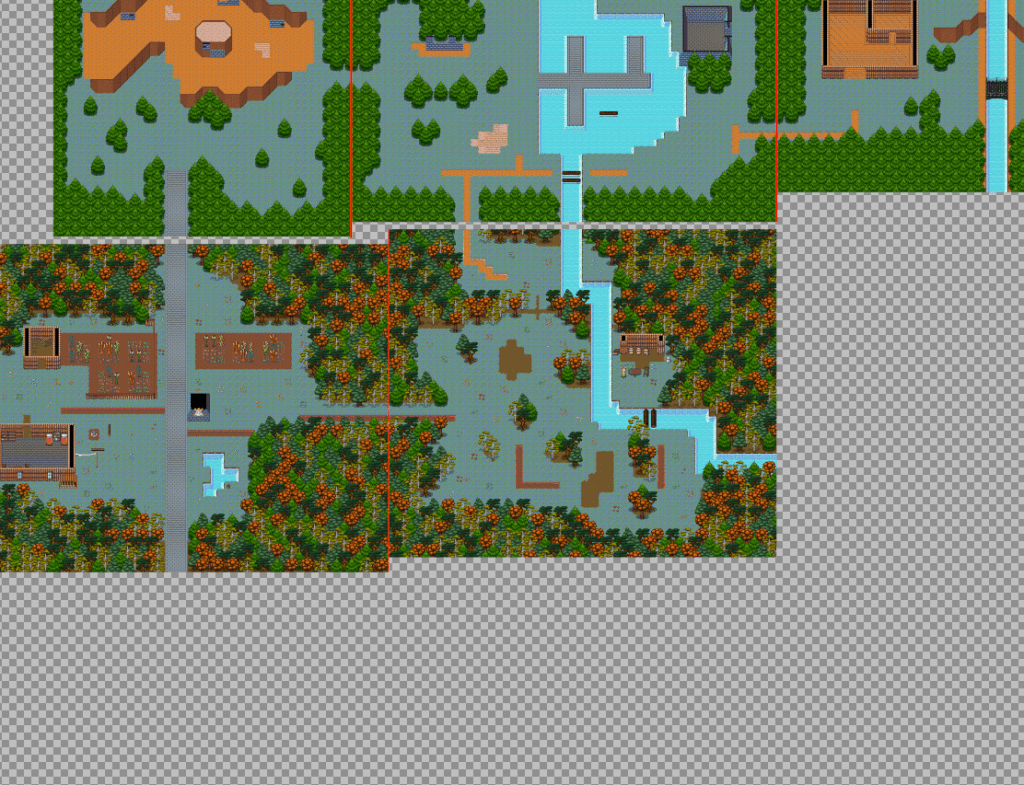
Now we add this to our overall image to make sure everything fits together and looks cohesive. There’s a fisherman near the farmhouse, the rivers and paths line up, it’s possible for the player to quickly move across the map when trying to travel, and there are corners to put goodies, huntable enemies, and monster patrols.
While I’m making this, I am thinking about what the player might want to examine. The barrels (full of fish), talk to the NPC, and on the nearby farm, someone maybe left a note that says “Gone fishing, back later”. This creates a little narrative in the player’s head, and makes the world feel contiguous and alive. The farmer sometimes goes fishing, takes the fish back and either eats them, or takes the Imperial Highway down to Poterup village to the south to sell them. The Imperial Highway is a paved brick road found in parts of the maps that connects all the important areas.
If I’m feeling really spicy, I could even randomly roll if the fisherman is fishing or at the farm, and reroll it whenever the player rests.

A bit on interiors. Interiors tend to have more straight lines in them because people like building stuff in straight lines. The villa tiles in the Old Capitol Grounds make a lot of use of courtyards, gardens, and small rooms attached to larger promenades. As these are ruins, they’re beaten up, falling apart, and have some people living in them in some places or are overgrown.
This is basically what I do when creating initial map layouts for the chapter. I wasn’t as severe in my planning for Chapter 1’s layout but I did go back and edit a lot of things to improve them, whereas I feel like most of Northwoods and Westwoods are really good on their first passes.
When I’m going hard on maps, I try to get three done a day. These take a couple hours each to handle detailing and whatnot, but even if you do think it’s not a lot of labour, it’s all creative work and your brain starts to run out of gas after three maps. After that point it’s time to go do something else.
People Asking Things About Nouns

A cavalcade of links
Where to find us:
Our Patreon and Subscribestar are great places to support development! You can also get cool bonus stuff like concept art and early releases of Pandemonium!
If you want extra pictures of cats, you can follow us on Bluesky.
And there’s always Our Discord. You can shout at Salty *in person*.
You can ask us anonymous question on Whisp.sh. If you’ve ever wanted to get smarmy answers to questions, or just know more lore, that’s the place!
We also have a Wiki! We’d appreciate it greatly if people keep it maintained for us. :3
Bottled Starlight Games:
Runes of Pandemonium, the big adventure TF RPG, always free on Steam and Itch.io.
Witch Hunter Izana, a battle-TF RPG. Available on Steam or Itch.io.
Witches of Ravenbrook, a battle-TF dungeon-crawler. The prototype is out now and free on Itch.io.
String Tyrant, a survival horror game, is on Steam and Itch.io.
Other Bottled Starlight Stuff
Salty writes a book series, with audiobooks and illustrations, called Tales of Strings.
Instruments is out now on Itch.io.
Passed Hand is now on Itch.io!
Spiderweb Theory is now on Itch.io!
Urban Explorers is now on Itch.io!
Mario is currently working on bringing the Pandemonium story series to Itch.
We have some ridiculous merch on Redbubble and Teepublic if you want to be the center of conversation (derogatory / celebratory).
 Pandemonium Development