Development Update: Censored Version!

Quick Update:

Finished the map glue, fixed some bugs. Urimas made a moth sprite. Stinkehund is making the title screen look better since it has more corgis. Chicken chalked March as literally her most productive ever. Good job, Chicken.

The Important Stuff

Today we are proud to announce the censored version of HoP: Remastered. This will include Classic, Corrupter, Adventure, and Doll Manor modes.

That’s right, to reach a larger audience when the game goes on Steam/GoG/etc. we want to make sure the game can be played by all ages. Naturally, a game with sex, female nipples (thanks, Tumblr) and hand-holding isn’t going to be received well. So we’re going to create a censored version, and the full proper naughty one can be downloaded by interested parties.

As a bit of a teaser, I had local programming victim and pizza fascist MarioneTTe pick a scene to censor, and we’re posting it for you to enjoy. You can click on this link to read it. This is the Mei Alraune Loses to Bee cutscene, except for all ages.

Here’s an excerpt!


A variety of fruits and treats grew in the forest, and Mei had gathered many of them to earn a few coins back at the trading post. She wondered which the bee would enjoy the most, as she had not thought to gather flowers, and quickly decided that one of the two large melons she had found would be the perfect offering.

She pulled her melon sling from her leafy pack, and the bee girl’s attention snapped from her polished lollipop to Mei’s melons even before she had pulled the first melon free from its sling. Her gaze drifted over them with wonder as the first melon popped free, and Mei wondered briefly if the bee girl had ever seen melons before.

With a slight shrug, and a bit of pride at possibly treating the bee girl to her first taste of the forest’s bounty of fruit, she gave the melon to the awe-struck girl. The girl grasped the melon in her hands, her nails biting into the soft flesh of the fruit, and Mei gasped as the bee’s long, almost prehensile tongue began to wash over it.


Now I know what you’re thinking

“Gee Salty, where can I find a loincloth that doesn’t chafe?”

Or, if you’re not a barbarian:

“Haw haw, Salty, it’s April 1st. April Fool’s day. You’re so funny. Get back to work you slovenly simpleton.”

Well it’s time for me to pull the biggest April Fool’s joke of all.

This is not an April Fool’s Joke, we are actually doing this. Seriously.

Except instead of being an all-ages thing, it’s just us deliberately mocking people who clutch pearls at the thought of sex. Every single H-scene will be written to involve lollipops, candy, drinking and enjoying cold milk, and friends getting together to watch silly inoffensive movies. All body parts will be censored in the art in the crudest ways possible, including corgis over female (and male!) nipples, as well as corgis censoring non-sexual things like Florentina’s knees and 55’s boots because girl those just don’t work on you.

All weapons will be dummy/blunt/nerf versions. Attacks will change from bleed to “give rugburn” and “bonk” instead of “pommel bash”. The ghost maids… well they’re still ghost maids since overprotective parents only seem to get upset about sex, not death and nihilism. So the nihilism stays!

As for when we will do this obvious comedy, that’s up for debate. Probably much, much later in the game’s development. But it is definitely on our to-do list. If you thought the above passage was funny, then just you wait.


Witch Quest: A Game You Should Play

Hey kids, today in yet another poorly-thought-out Design with a grain of Salt, we’re talking about Witch Quest. It’s a video game for your computer TV machine.

Background

Witch Quest is a game being solo developed by AngelGrace, a lunatic. You have to be a lunatic to be an indie game developer these days.

It was first released in October 2014 and has most recently been updated in November of 2018. The game is (according to Grace) about 40% complete.

I’m not going to get into the bugs here. The game has many, and Grace is going to fix them. You can’t criticize an author for bugs if they’re making an effort to fix them, we’re worried about cases where the author is ignoring bugs that damage the experience.

The First Act: Or, Why Getting to the Point is a Good Idea

Video games do not follow the same three-act structure that was first codified in ancient Greece. As a different medium for the telling of a story, they simply cannot be described in the same manner since the audience are the actors in a video game. That said, some of the terminology can be borrowed. So, what is the first act of a video game?

The first act is what happens right after you start a new game, and ends when we know the following things:
What the conflict is.
Who the protagonist is.
What motivates the protagonist to take up the conflict.
What you (the player) are going to do to solve the conflict.

That’s your first act. When you know the answer to all these questions, you are currently playing the game. Everything before that is the first act, and you’re not really playing it.

Witch Quest gets the first act out of the way in 2-3 minutes depending on how fast you can read. We get an intro blurb, Star (our hero) goes to help the priest, finds a magical artifact in the basement that reveals her power as a witch, and immediately fights off a villain who has come to conquer her hometown. She then gets booted out of said hometown because the people there hate and feat witches.

Bam. Done. We know the conflict (witches are taking over the world), the protagonist (Star), her motivation (she does not want to succumb to evil and wants to find a way to save both herself and humanity), and what the player is going to do (talk to people, explore, fight enemies).

It probably seems odd that I have to point this out, but I’m going to give you some other examples. Watch this video. The first act ends, for me, at around the 2 minute mark, when Doomguy crushes a zombie’s head. At that point we know the answers to all the questions. Conflict? Demons are invading. Protagonist? Doomguy. Motivation? Kill everyone. Method? Kill everyone.

Meanwhile, another modern game, Dying Light, takes over 30 minutes to finish its first act. It has extended cutscenes, tutorials, and other segments of not-gameplay. You don’t feel like you’re playing the game until you first get out of the tower and are allowed to run around freely. That’s when the first act end, because we know the first three questions but not the fourth. In Dying Light, the game is about parkouring around, fighting enemies, and looting stuff in a free and open environment. Tutorials thus are part of the first act.

Games need to get through their first acts as quickly as possible because we, the players, are not here for them. We’re here for games, not movies. Get the first act out of the way quickly. Witch Quest does this very well. Good work, Grace.

Active and Reactive Protagonists

Another common theme in narrative game design is the protagonist being active or reactive. In other media, a reactive protagonist is one who does not dictate the pace of the plot. They are running from their enemies, or are losing battles, or are hiding in the closet and just hoping no big monsters eat them. A reactive protagonist does not guide the plot, but is guided by it.

An active (or proactive) protagonist is on the offense. They are seeking out the conflict and trying to resolve it. They are attacking the bad guys in their forts or dungeons. Things happen when they show up. If there’s a monster in the house, they’re avoiding it and hiding while setting a trap for it.

Star is an active protagonist. Kicked out of her home, she sets off to right wrongs. When a priestess tells her of something wrong with a nearby shrine, she volunteers to help. She’s a witch with awesome magic powers, so she’s going to take the fight to the enemy. Witches have been abducting little girls and secreting them an academy to indoctrinate them into witchery? Star infiltrates the academy and confronts the headmistress directly. There’s a strange blizzard freezing the land? Star climbs a mountain to see what’s wrong at the shrine there.

Active protagonists are both more fun to follow, and more fun to play as. You, the player, feel as though you are making some progress towards solving the conflict. Star grows more powerful quickly and even starts besting some witches. It seems with a plan and some help from friends, you really can save the world and overcome the fate that seemed impossible to avoid early on. Narratively this is very satisfying.

The Fundamental Game Loop

Okay, so this is going to be a bit of a controversial point. I have determined what the true game loop of all video games is, so here it is.

Video games are about going around, slaying people, and taking their valuables.

Not every game ever made uses this loop, but for a game which has a game loop, this is usually it.

Dragon Warrior: Go around, find monsters, kill them, take their money, get better stuff to kill tougher monsters. Repeat.

Doom: Go around, find monsters, kill them, loot the rooms they were in. Repeat.

Battle Royale Games: Go around, find loot, find players, kill them, take their loot. Repeat.

The reason why this is an effective game loop is because each of the parts feeds into the others. More money = better stuff to kill with. More monsters = more killing = more money. Reaching new towns means they sell better stuff to kill monsters with. Dungeons are loaded with tougher monsters and loot to kill those monsters with. It feeds in on itself.

Witch Quest gets right to this. The third battle of the game results in Star making a new friend, helping to save the forest, and being immediately rewarded with an item to boost her stats. Beating up other enemies usually causes them to drop items which give buffs. The loops feed into one another.

By way of criticism, Witch Quest is rather straightforward. There are no additional battles if you want more loot, and functional item shops are rare. You can’t really spend the cash you get. But, your characters do get stronger as a direct result of battle. Yes, there are games where you grind against enemies to gain levels but the levels aren’t worth squat. This isn’t one of those.

And if that wasn’t enough, besting enemies will give Star news spells periodically. It’s just like slaying enemies and taking their stuff, but in terms of magic!

No Padding

Witch Quest doesn’t screw around. There’s a few hours worth of game in it, depending on how fast you can read. It’s not padded, almost all of that time will be you doing something. Exploring, talking, brutalizing a victim, taking valuables, getting tougher.

Well, I suppose I’ve said enough. It’s time to talk about Helpless Heroine.

Helpless Heroine is how not to do these things

Helpess Heroine is a game made by KevinBach, first released in December of 2014. They were fairly close in terms of release date, though HH is “Complete” as of 2017.

It’s probably the most padded game experience I have ever had.
The protagonist is reactive for the first 16-20 hours of gameplay.
The game loop is non-functional since characters exit your party after every dungeon and may not be worth levelling up. The items found in a dungeon are ones you can buy, sometimes before even entering the dungeon.
You will quickly hate all the characters as they are selfish, vapid, violent, and shallow.

I wrote this article because I felt the need to compare the two games and see what they did right in relation to one another. The only thing I can say positively from a design perspective on Helpless Heroine, is that there’s a lot of it. Oh lawd there is a lot of it. If you like vore, petrification, and other ryona brutality, you’re going to find heaps of it in this game.

But, the most important point of comparison is that the first act of Helpless Heroine does not end until about 12-15 hours in. That’s a three hour window because fleeing from battles or not dying to party-stun group wipes is RNG dependent.
At the 12 hour mark, Onyx finally fights back and kills one of the game’s villains. Before that, she has spent the game fleeing. Helpless Heroine focuses on a reactive protagonist, is almost comically padded, has an incomprehensibly long first act, and doesn’t have a game loop until around 16 hours in.

Most people panned Helpless Heroine. In the ecchi game genre, we basically play things that interest our particular kinks and are delighted when they don’t suck. If something is not to your liking, few H-games are going to make you want to play them anyway. Helpless Heroine is the poster child for this. Its defenders are staunch, its creator surprisingly hostile to criticism, its gameplay terrible.

You deserve a better class of game. Witch Quest is trying to be that. Even if you’re not into the sort of game it is (transformation, monstergirls, corruption), it’s still worth a playthrough, because it’s fun. It stands on its own. Play Witch Quest.

Criticism

What, you thought this game would escape criticism? Hell no, this is Design with a Grain of Salt, people.

First, Witch Quest is a one-angel-show. All of the graphics and sound are stock assets. This is fine as far as it goes, but there are other resources for free assets. Grace, I know you’re reading this (because I linked it to you. Hi!), but you can totally grab free stuff from elsewhere on the web and use it. This goes for you aspiring designers out there, too.
Places like opengameart.org have sprites, music, tiles, and backgrounds. Try to get them to fit the mold and pick assets which match the stock asset styles, and your game will look and feel better. You’ll stand out from the crowd.

And, since you’re “Under the radar” and not looking to go professional, you can therefore wholesale rip stuff from other games. This goes for other game developers who are making non-professional ecchi games: Go nuts! Borrow from Final Fantasy or Darkest Dungeon! Copyright laws are stupid, this is your chance to stick it to the man! It’s not legal, but the odds of getting a takedown notice are slim.

Second, there are some areas where the camera focus and map design are fairly clunky. It is a common belief among RPG Maker designers that their rooms must fill at least one full screen. This is false. Make the levels small enough that your player doesn’t need to spend too much time running across them. Remove buildings that don’t matter, or have them in areas of the map that the player doesn’t need to traverse. Ask yourself “Is there a reason the stairwell is 15 steps away instead of 5?”.

Third, we’d like a game loop to occur, and ideally around the time the player exits the catgirl village. My suggestion would be an area where the enemies respawn whenever the player reloads it, so they can fight the enemies within as many times as they like. Put a shop in the holy tower so the player can buy supplies. Otherwise, keep the every-enemy-a-miniboss design the game currently has.

Fourth, avoid stun and instant-KO attacks in enemy AIs. The Yuki-onna fight is extremely hard because it’s entirely possible to have the party chain-stunned by blizzard freezing the party. Ward doesn’t counter it. Stun/KO attacks are just not fun to fight against, they are dice rolls as to whether or not the player loses the battle.

Fifth, scale back all the spells to the same cost and base power. Going up against enemies that are weak to fire means you should use fire spells, but since Star regenerates MP anyway, using higher-cost wind spells actually does more damage since their base power is higher. Then, have her learn higher ranks of elemental spells (this already happens in the academy for three of them!) so we feel like Star is getting more powerful as the game goes on.

Sixth: Secrets! There are presently only a few minor secrets in the game, and they’re just examination text. Give us extra items or abilities for exploring, and the game becomes so much more engaging.

That’s all for now. Keep making the game. We’re all eager to see where it goes and will wait with bated breath for the next update.

Development Update: July 16th, 2018

Before the poll results, a quick update

Everyone is back to work as of this week. I’m still recovering from my back injury so I’m working at about half speed, everyone else is working as normal.

I’m about 80% done my trello list for Prototype 5-2c and v105c, which will contain bug fixes and a bunch of small feature upgrades. Let’s take a look at those shall we?

Combat Icons

CombatIcons.png

As part of a quality-of-life improvement, the hard-to-read text indicators have been replaced with these handy icons. The icons remain in fixed positions on the UI and are nice and clean to navigate. Urimas is currently finishing up the last of the icons for 55, and these will be in next week’s release.

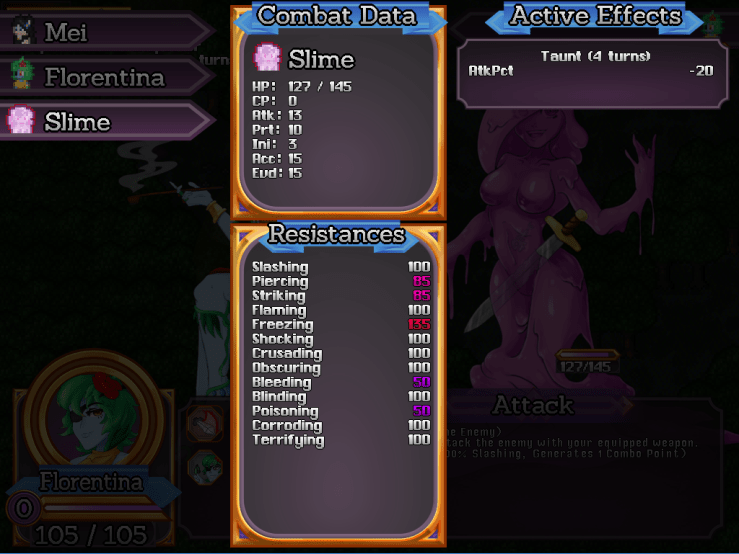
Combat Inspector

CombatInspector.png

The Combat Inspector has been brought in line with the new UI and is more functional and easier to read. The layout is not finalized but it will do its job for now.

Ability Inspector

AbilityInspector.png

You’ll now be able to check your abilities on the status screen, getting a better idea of their properties with long-form descriptions. Very handy if you want to check what something does outside of combat to formulate a strategy.

Many, Many Bug Fixes and QoL Improvements

The full changelog will be posted next week along with the next version. For now, let me say that I took your reports to heart and did as much as I could within the scope of 5-2’s release. Some changes got pushed to 5-3 since they’ll take a little longer or require more scripting.

Poll Results

Let’s get to the good stuff. This week we had 23 respondents on the steering poll.

Result00.png

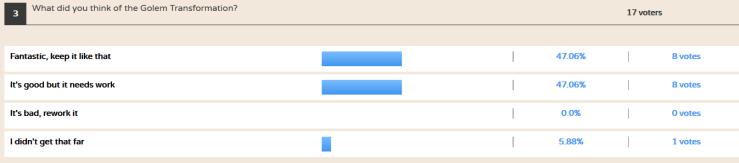
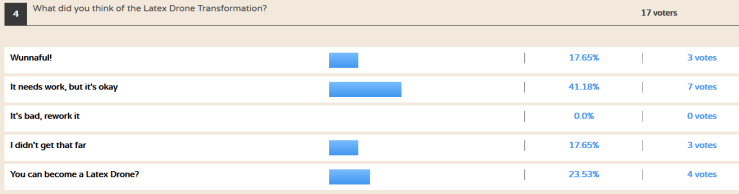
So Steam Droid’s transformation won with Latex Drone coming in second. I’m going to ask the public what they think we could do to improve Eldritch Dreamer and Golem on the forums, but I’m happy with this. Editor MarioneTTe is the one who wrote the Steam Droid transformation, so I’ll try to coerce him into writing more in the future.

Result01.png

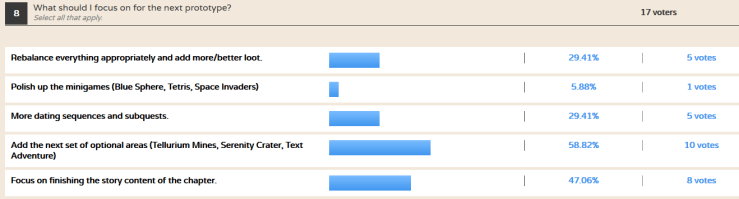
Character development takes priority? How did this happen? But in all seriousness, 55’s dialogue topics will be my first priority, followed by the Text Adventure side content (I’ll explain myself at the end of the poll) and then the main story content. Sophie’s extra events will not make it into Prototype 5-2 (most likely) and nobody wants me to improve the minigames. So those are right out.

Result02

This is about what I had expected, considering the state of the minigames. I’m going to be cutting all three and worrying about proper game content now.

The original purpose of the minigames was to provide a way to generate as many work credits as the player could stomach. However, that’s obviously no longer necessary with the addition of the Tellurium Mines. As such they’re redundant right now and polishing them would take time away from Chapter 5’s scenario work.

If it does become a thing in the future, Space Invaders will be the one rescued from the trash heap. But don’t count on that.

Result03.png

So this presents a dilemma, because you want more stuff to do with Sophie but want me to prioritize fireside chats with 55 and story content. Well, the next section of the story content is going to feature Sophie, and I’m thinking of adding another area to Regulus City that you’ll be able to visit with her. It’s a tricky spot to be in but I think I can manage it.

Result04

The extra content is definitely a go. That’s a pretty solid majority that wants to see the characters from the original Chambers of Pandemonium go up against doll girls. And by that I mean become doll girls.

Exactly how much this will add to 5-3’s development schedule I cannot say. The fact that it’s an independent game mode does mean it doesn’t need to 1:1 match the art style of Adventure Mode, but it probably will since that’s just simpler to do. More on this mode as I develop it.

Wrap Up

I expect Prototype 5-2c will be released next week with all the bug fixes, and after that I will begin a promotional tour of the internet to tout this game everywhere I can. I would really love it if we got enough contributions to hire a musician and to let me work on the game full time.

If you’re not a supporter, you really should be. 1$ really does go a long way.

Argue about this post on the forums!

Support the game on Patreon!


Development Non-Update: July 3, 2018

So, this is sort of a non-update but it will allow me to make sure everyone is up to speed.

At 12:30am on Thursday of last week, one of the muscles in my lower back gave out and I collapsed. This is the third such incident in the past five or so years. For about 18 hours I was unable to even sit up and had to lie on the floor. After that I had enough strength to get into my bed and I’ve been slowly recovering ever since.

As I write this it’s Tuesday morning and I have my MacMini hooked up to the TV at the foot of my bed so I can type things without having to hold a sitting position. I can sit up for short periods but it’s uncomfortable. I can also walk very slowly (extending my left leg past about 30 degrees causes the damaged muscle to contract) for short periods. Using the washroom unassisted has, on multiple occasions, been a heroic act but I can do it reliably now.

Pandemonium is basically my favourite thing. I love making it. Fixing bugs is fun to me, writing the dialogue and scenes is a blast, and I love fleshing out the setting and characters. So being unable to even touch it for the past five days is more painful than my back problems. But I have not stopped trying.

I know from the previous times this has happened that my back will be improving slowly over the course of the next few days. Everything will probably be back to normal next week. Development will resume as normal and I’ll be trying to get a patch out to fix all the bugs that have been reported (thanks, everyone!).

So, if you’re new to this project, every week I normally post an update about the project status. That’s this. The project status is my back’s status.

I’m looking into purchasing an ergonomically designed chair to replace my current chair. The most likely cause of my back injury was the 12+ hour sessions I spent in the lead up to 5-2 working on Pandemonium in a chair that was placing strain on my back muscles. I’m not letting the injury stop me.

I want to make Pandemonium my full time job. I want it to be the full time jobs of the artists I work with. If you’re reading this, even if you’re not a patron, you’re helping make that possible. The response to v1.05 has been enormous. We got 50 new patrons in the past month alone. The pride of that accomplishment means I know we can pull this off and that my injury is a temporary setback on that road.

If you’re having problems with 1.05b, here’s a link to the discussion thread where I will try to answer any questions you have and provide workarounds for common problems until I can get a patch out. If you’ve stuck with me this far, the Patreon is going to have some bonus content out later today.

I had intended to have a Patron Steering Poll today but that’s postponed for obvious reasons. Should be out next week.

Thanks for sticking with me so far and here’s to the next release.

Bad News for OSX Users

Right, so first, here’s a link for you to read: Apple is going to deprecate OpenGL support.

Now, what does this mean? It means OSX users may be in a tight spot, though probably not immediately. Those of you who are OSX users already know that Apple hasn’t been updating its support past OpenGL 4.1.

Pandemonium runs on OpenGL, though fortunately it does not require any of the advanced features in the later versions. Apple is deprecating support, but OSX should still run the game just fine unless they intentionally drop support at some point.

So, if you’re an OSX user, here’s the state of things: Until Apple completely drops OpenGL support (which is not a given), you will be able to play Pandemonium natively. If/when they do drop it, you won’t unless you deliberately block system updates.

I expect Apple, being monopolistic idiots, are still not dumb enough to deliberately drop support for years to come. As such there is a good chance that this will not affect Pandemonium, though it will definitely put a chill on further development on OSX. After all, why should I bother optimizing it if all my work might be lost?

The primary reason I decided to build the engine in OpenGL was its cross-compatibility. OpenGL can work on any system anywhere because it’s an open standard. Anyone can write an implementation. Windows, OSX, Linux, they all work with OpenGL. Apple is now pushing their new graphics library, Metal, in place of OpenGL in an attempt to gate off content and force users to buy macs in order to play specific games.

As an indie developer, I don’t have the kind of resources to overhaul all of the code for Metal, with the attendant bug fixing and feature changes that go with it. The only reason we currently have an OSX build (and soon, a Linux build) is because there’s not that much coding in porting it when they use the same graphics API. Forcing the usage of Metal removes that advantage.

Again, I don’t think this will affect Pandemonium itself unless Apple does something amazingly shotgun-to-foot stupid (you know, in addition to this current shotgun-to-foot stupid action). But it does bring a few things into focus.

Apple is a big company, and they received billions in tax cuts recently. They can certainly afford to maintain their OS support for OpenGL. This is pure monopolistic money-grabbing. Further, this is an example of a major corporation taking a unilateral action which will make the industry and the science of computing worse. I’m sure there are advantages to Metal, but kicking independents artists in the teeth like this slows down the generation of culture. Scientific applications on OSX will also be affected since OpenGL is very commonly used there (disclosure: I am a BSc in Geology, I’ve used such applications).

And of course, because of the structure of American capitalism and its total lack of anti-trust enforcement, we, the public, have absolutely no input on this. Apple may or may not make lots of money, but we will suffer for it. Our overlords decide and we have no voice.

If you’re an OSX user, hopefully WINE will continue to suffice for your purposes. You may also want to consider dual-booting to Linux as I hope to have a Linux build out for Prototype 5-3.

Update: Fortunately, there is some good news. Despite Apple’s intransigence, Vulkan support is on OSX. So, I may just provide Vulkan support to thumb my nose at Apple, and we’ll have a Pandemonium that will be compatible for future OSX users.

The Weapon Upgrade System: A Discussion

Right, so I’ve been thinking on this issue for a while now and I decided to compile my thoughts into a post so other people can ignore read them. Yes it’s about Pandemonium’s internal system dynamics, but I promise to keep it high level.

It also doubles as a Design with a Grain of Salt post.

The Weapon Upgrade System

To put it briefly, in Pandemonium, the player can upgrade their weapons and armor using Adamantite. Adamantite is found in the environment and can be purchased in some cases.

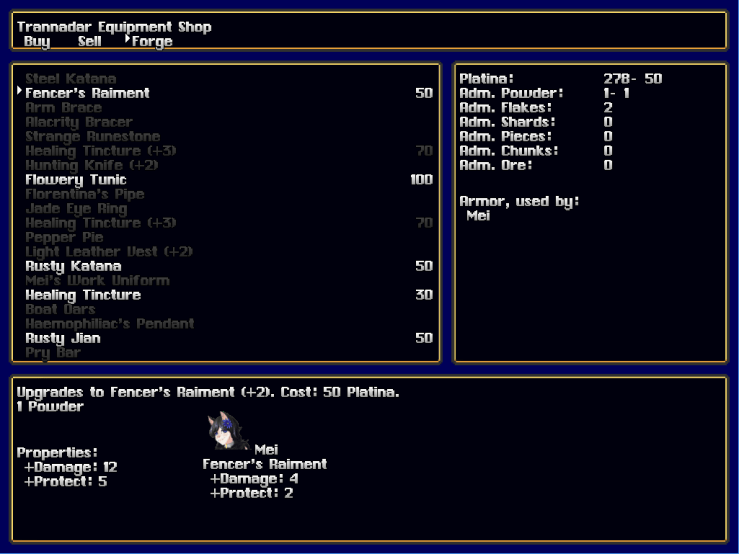
Upgrading a weapon gives it a suffix, such as Fencer’s Raiment (+1), and increases its statistics. Every piece of equipment has a different upgrade path.

ForgeExample.png
(The Forge UI hasn’t been overhauled yet, 100 bonus points for the first person to spot the obvious bug!)

What it does to the game

Being able to find items in the world that you can use to improve your existing inventory produces a few obvious effects.

  1. The player wants to seek out every treasure chest because more adamantite is always useful.
  2. Cash is always useful. You’ll never really have too much since every character needs to upgrade their equipment.
  3. There are fewer pieces of equipment to be found, and equipment is never discarded since no one weapon is really “better” than another when upgraded.

However, as I was developing this system I found a major downside to it that I had not considered. Highly upgraded equipment discourages the player from experimenting or specializing.

If I made a piece of equipment that has excellent fire resistance, but it’s found later in the game, no player would ever actually use it because by the time they found it, all their existing equipment is at +5. This piece of equipment gives fire resistance but unless the enemies in one area are exclusively dealing fire damage, the overall better stats of a +5 piece of equipment outweigh the increased resistance. The best case scenario would be a player upgrading the fire resistance item, using it for one area, and then putting it aside until they find another area where enemies deal fire damage which may not even exist in the game.

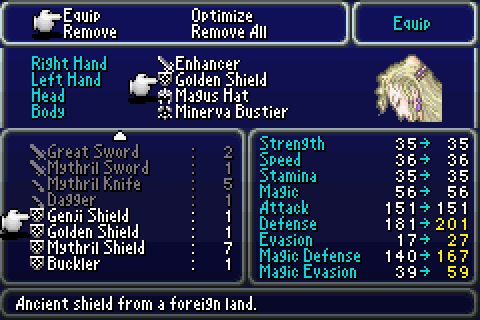
In games like Final Fantasy, your party is constantly finding new weapons and armor. There are even Optimize options on the equipment screen which instantly equip whatever has the best overall stats. This is something I wanted to avoid because it’s one of those situations where the player doesn’t get to make an interesting choice. If a piece of equipment has better stats, equip it. Duh. You don’t need to choose what to upgrade, you just need to choose to hit the Optimize button periodically.

Optimize.png
Final Fantasy 6, GBA Version. Mash that Optimize button!

So I want to encourage experimentation and interesting player choices at the same time. How the hell do I do that? Well, I need to make things more flexible.

Possible Solution A: Recycling

This one I’ve given some thought to. Essentially it allows the player to “Recycle” an item, decreasing it back down to its (+0) state and removing all bonuses, as well as refunding all adamantite and cash that went into it.

If you want to experiment, you can take your +5 gear and downgrade it all back to its base properties, then upgrade something else. If it doesn’t work out, downgrade that gear and get all your +5 back. You don’t even need to make a new save, because there’s no real loss to doing this.

A possible lemma to this solution is that perhaps we don’t refund 100% of the cost. Some games like to do this, but as far as I’m concerned that’s just there to make the player grind for longer. If I want to experiment but it will cost me 3000 Platina to do so because that’s how much I’ll lose for recycling, then that’s 3000 Platina I need to grind (or just make a new save file and reload). So while this is a possibility, I don’t view it as a good one.

Benefits: Allows experimentation and flexibility with the equipment. Internally, Pandemonium is set up for this, as the upgrade table can just be run in reverse.

Downsides: Adds complexity to the game. Recycling is a system I need to explain to the player, and some players may skip over it just because it’s extra complexity.

Possible Solution B: Per-Slot Upgrading

Another possibility is that each character could upgrade their equipment slots instead of upgrading the equipment in that slot. Yes, that sounds insane, but from a game-mechanics standpoint it’s perfectly valid.

What this would mean is that Florentina would upgrade her weapon slot to +1, and then any piece of equipment she puts there is a +1 regardless of what it is. Swap the Hunting Knife for the Butterfly Knife, and it instantly becomes a +1.

This has a different problem in that it makes equipment sharing more difficult. If a character is upgraded and not the equipment, then characters can’t swap equipment between them. Pandemonium only has a few pieces of universal equipment in Chapter 1, but it becomes more prevalent as the game goes on. All characters have unique weapons, but armor is divided into Light, Medium, and Heavy, while Accessories and Combat-Items are much more flexible. In Chapter 6 the player can build their own party composition, so swapping equipment around becomes much more important.

Naturally, the solution to that problem is Recycling character slot upgrades, which puts us right back to Solution A but in a more convoluted fashion.

Plus, this is really weird lore-wise. I can understand making a weapon better, but somehow dusting Mei’s wrists with adamantite makes her better with her sword? How? There’s already a mechanic which makes characters stronger, it’s called Level-ups!

Benefits: Allows experimentation within a character’s equipment range.

Downsides: Discourages experimentation between characters. Weird to explain from a lore-perspective and probably convoluted to tutorialize.

Possible Solution C: Remove the upgrade system

Easiest to implement mechanically, I just remove the upgrade system and go with the Final Fantasy system. Obviously falls victim to the sunk cost fallacy since I’ve already designed and built the system and scrapping it causes me to lose all that work. (Also, if you followed that link, I do not endorse Kahneman’s evolutionary psychology hypothesis for the fallacy’s origins. That’s just flat out bad science.)

Benefits: It’s really easy. I just remove all vendors capable of forging and remove or repurpose Adamantite. Players who have it in their save file can be compensated the next time they load it. Very simple to understand, doesn’t require tutorials.

Downsides: I’d have to add a lot more equipment items to replace Adamantite. Probably need to add an Optimize button to the equipment screen.

Possible Solution D: Go Full Ham on the upgrade system

Rather than allowing multiple pieces of equipment, the player only ever gets one piece (Ex: Mei’s Rusty Katana and Work Clothes) and doesn’t find new ones. Instead, all equipment changes are done via the upgrade system.

The upgrade system no longer needs to be done in shops and no longer costs money. Instead it may look something like this awful prototype image:

FullHam
The whole hog is a whole different flavour

In this system, you can add or remove upgrades at any time by inserting/removing Adamantite from the slots. I would have an indicator on each upgrade as to how much it costs of each Adamantite type. Each upgrade can be undone and will return all of the Adamantite used, and this can be done in the field (or possibly at save points) for free.

Once again, this system is complex as all get out, and would require some explanation for the player. I’d also have to change a great deal of how the equipment is handled internally, so there’d be a lot of coding involved.

It’d also be a pain in the neck to balance properly, but that’s a trial-and-error thing.

There is also no particular reason why I could not allow multiple pieces of equipment, but it would mean I would need to create upgrade charts for a lot of items. This would allow some items, like Fencer’s Raiment, to have a lot more offensive options in their upgrade chart than something like Light Leather Vest.

Benefits: Allows for a lot of interesting choices and allows experimentation and specialization in the field.

Downisdes: A lot of coding work on my end (probably. I’m very clever.) and very complex. Would likely require a detailed set of instructions available in the game for confused players. Would require a new UI with attendant control mapping charts.

A Plea

So, that’s the state of the system and how I see it. Now, if you’ve read this far, the congratulations because you’re literate or you skipped to the end and I admire your guts for admitting it. But also, you must have some thoughts on what I should do. Want to tell me what to do?

Go to this forum and hurl your ideas at my head. Whatever we wind up deciding on, it probably won’t make it into Prototype 5-2, but will probably make it into 5-3 or Chapter 5’s full release.

Oh, and here’s the obligatory link to my patreon. I’ve been told I need to post this at the end of every blog post because that improves engagement or something.


Coding With a Grain of Salt: Ray Tracing and Blockmaps

What the hell is ray tracing, and what the hell is a blockmap?

Ray Tracing is the coding technique used to figure out what can be ‘seen’ from object to object. If you’ve ever played a first-person shooter, you’ve experienced a ray-tracer, because that’s how the game determines what parts of the map you can see and what parts you can’t. Objects in the foreground prevent you from seeing what’s behind them.

Ray Tracing is simply tracing a ray. A Ray is a geometry concept, it’s a line that starts from a point and travels in a direction until it hits something. In strict geometry, rays don’t hit things, but in our code they sure do.

Oh, and this would more accurately be called a ‘line-segment’ as opposed to a ‘ray’, because these have a definite end point. But since the code can be generalized to rays and ray sounds a lot cooler, I’m using ray.

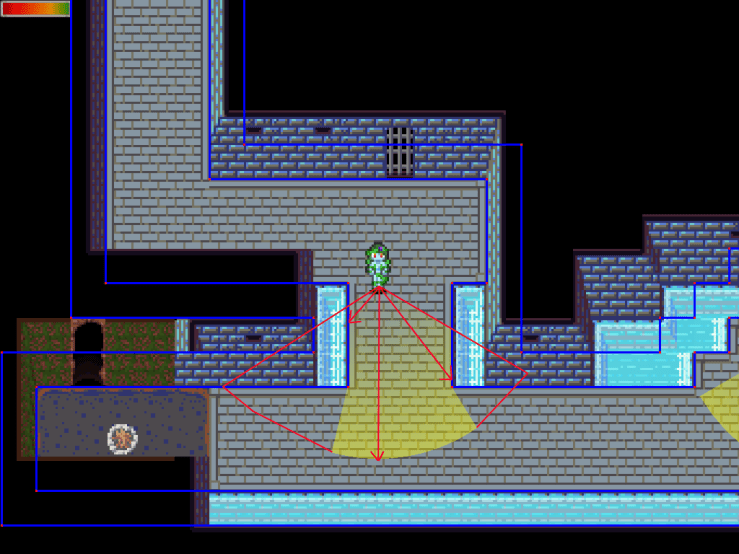
Pandemonium uses ray tracing to figure out if an enemy can see you, the player. If the enemy can, they will chase you and trigger a battle. So it makes sense that they wouldn’t be able to see you through walls unless they have x-ray vision.

RayTraceA.png

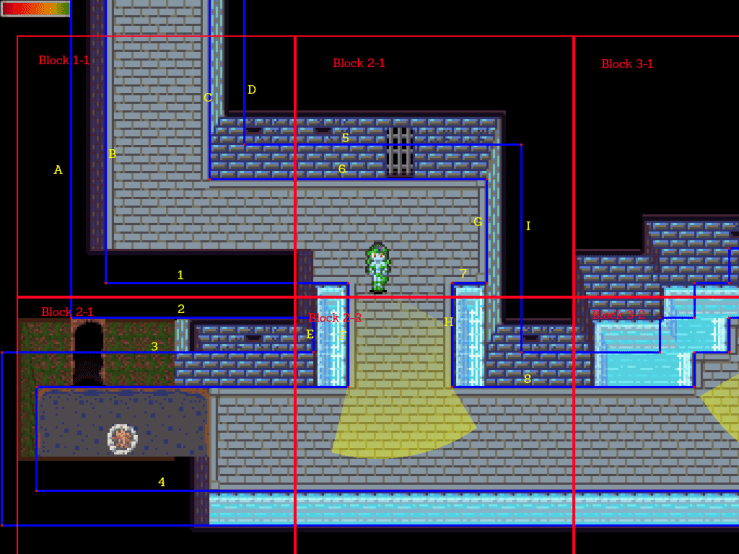
In this image, I have enabled Mei’s visibility cone to simplify things. The yellow area is what she can ‘see’ while the red polygon represents what she’d be able to see if the walls weren’t in the way. The red arrows are rays, and they collide with the blue lines which represent collisions.

Pandemonium does not simulate verticality. So, enemies cannot see over the water, because they can’t chase over the water. It’s one of those design decisions that makes a lot of sense from a gameplay perspective but not from a reality perspective.

Okay, so what’s a Blockmap?

Raytracing is computationally expensive. In order to see if a given ray impacts a line, we need to run the line-intercept function. It looks like this.

I sincerely hoped you enjoyed that link.

The line-intercept function must be run for every line in the entire map against every ray you want to trace. For Pandemonium, every viewcone is about 120 rays. You can customize the accuracy in the options menu if it causes slowdown. 120 is just a good middleground number that looks nice without being too intensive.

So, if there are 600 lines in a map, and 120 rays per viewcone, then that’s 72,000 calls of the line-intercept function for every entity with a viewcone. 600 is not an unreasonable number of lines, and some of the larger maps have thousands of lines. This gets expensive, quickly.

It sure would be handy if we had a way to only check a ray against the lines it could reasonably impact, as opposed to every line on the map. The rays are short and always focused around the same spot, so an optimization would mean instead of checking against 600 lines, we check against 10.

This optimization is called a Blockmap.

What does a Blockmap look like? How does it work?

Blockmaps simply sort the lines on the map by where they are.

RayTraceB.png

Here we can see a crude overlay which shows what a blockmap might look like. The vertical lines are labelled ABC etc, while horizontal lines are 123 etc.

Block 1-1 contains lines A, B, C, D, 1, 5, and 6. Any line which touches the block at all is considered to be within it. This can be determined with a simple line-intercept function call, and only needs to be determined once. That is, I can compile this data into the map and it never needs to change. Block 1-1 always has the same set of lines in it.

There are 16 vertical lines and 16 horizontal lines visible in this image, give or take the edges. That’s a total of 32 lines. If I had a ray that started and ended in Block 1-1, then I would only need to check 7 lines.  That means the Blockmap speeds up raytracing by about 500%. Five times faster for a simple bucketing algorithm, pretty impressive!

If a ray starts in one block and ends in another block, all you have to do is check all the blocks it hits, which can again be determined via either a line-intercept function or a point comparison. Simply check which block the start point and end points are in, and check those blocks as well as any blocks between them. For a short ray like the one in this screenshot, a ray can be in as many as 3 blocks, which is still considerably faster than checking every single line on the map. The algorithm becomes faster the smaller the blocks are, up to the point where the blocks are so small that the algorithm spends too much time figuring out which blocks the ray touches and not enough checking line impacts. It’s up to the coder to figure out the optimal size, but in Pandemonium it’s about 3-4 tiles squared since the majority of collisions in the game are big square right-angles.

Bonus Optimization: Duplicate Line Check

When a blockmap gets really small, the same lines start to appear in many blocks. It’s theoretically possible for a line to be contained in dozens of blocks, though that doesn’t happen very often in Pandemonium. When iterating across the blockmaps, checking the same line twice is just a waste of speed. What do we do?

The blocks contain references to the lines, which are stored in a single master list. To prevent duplication, we can use a unique ID system.

Every time a ray begins a trace, increment a variable, called mRayPulse, by 1. Every line in the map likewise has a variable, mLastRayPulse, indicating the last pulse they were queried by. When a ray checks a line, set the line’s mLastRayPulse variable to mRayPulse. If the ray goes to check a line, and the line’s mLastRayPulse variable is already equal to mRayPulse, it was already checked and we can ignore it. Thus we avoid all duplicate line checks.

We can also optimize the algorithm a bit by shortening the ray after each impact. Finding an impact is not enough, we need to find the shortest impact, otherwise entities would still be able to sometimes see through walls. Each time the ray impacts a line, we shorten the ray. If a ray going from Block 3-3 to Block 1-1 gets hit in Block 2-2, there’s no need to continue checking Block 1-1 since it has already hit something in between. This doesn’t save much processor time but is certainly worth mentioning.

Can we optimize this more?

Yes! However, it probably isn’t necessary in this case. Blockmaps with a duplication-proof pulse checker are ideal for short rays, such as the kind used in Pandemonium. Rays that are very long, however, are a different species altogether and won’t work with a blockmap.

For very long rays, you need a tree sorting method. If you’ve ever played Doom, Quake, or Half-Life, you’ve played a game that uses one such method: Binary Space Partitioning. This is where all the lines in the level is split into two (hence the term binary) and the two halves of lines are then further split down recursively until all the lines are isolated. The more advanced methods, Quadtree and Octree, do this same technique but use a different splitter to break space into four or eight parts instead of two. The basic principle is the same, though.

A BSP has the advantage of being fast for an arbitrary set of lines and line lengths, while also not taking up much RAM. Blockmaps are very fast for short lines and take up a fairly large amount of RAM relative to their contents, but for long lines they tend to check way too many extra lines.

I will probably do a post on binary space partitioning in the future but for now, this post is long enough and got its point across.

And for all those of you who don’t care about blockmaps but made it to the end of the post anyway: Congratulations!


Prototype 5-1 Poll Results

Project Update

So before we get to the poll, on the coding front I’ve added the backend for the new animations and updated some of Chapter 1’s scripts to use the new formats from Chapter 5. I got a lot of great bug reports from Prototype 5-1 and I’ve sorted those out. I’m also about halfway done the mapping for Serenity Crater.

Chicken is about halfway done the Golem Transformation sequence, which is about 3x longer than the usual TF scene entirely at her insistence. After reading what we had written for it, she wanted to make it longer and more detailed. Hooray.

Hund is currently working on the combat animations. I’ve got some alpha versions in the engine and I can tell you they make combat flow much better.

Urimas is currently working on new animations and tiles for Chapter 5. More on that in a later post.

Poll Executive Summary

(An executive summary is where you write all the conclusions at the top. It’s named for executives at businesses who don’t have time to understand useful things and need to make descisions based on hearsay, rumour, instinct, and other things that are well known for being wrong and stupid. You know, like executives.)

Prototype 5-1 was well received, we’re going to be doing more like it in the future, we’ll be focusing on more new content in infrequent and irregular releases, and everything is on track without need for major changes.

Now let’s get into the nitty gritty.

Prototype 5-1 Poll Results

Prototype51Question0.png

So this is about as expected. You can’t please everyone, but I’d be really worried if I got several “It was awful”‘s in there.

Prototype51Question1.png

Also about as expected, as I received a lot of feedback that the early areas were too difficult. Overall, the main story stuff should be easy-medium, while optional content should be medium-hard. So, the next prototype will tone down the early areas a bit as well as adding items to use that will make things easier. The chapter will slowly increase in difficulty as it goes.

Prototype51Question2.png

I’m assuming that the “needs work” crowd will be satisfied when the images for this sequence come online. I also think it needs to be a bit briefer (it’s easily the longest sequence in the game so far) and have a more sexual overtone.

Prototype51Question3

A similar result here, but more player’s didn’t know about the form being available as a bug in 5-1a prevented the cutscene from firing. If you’re one of those people, you can activate the cutscene from the debug menu.

Prototype51Question4

This is the desired result. Equinox is an optional area and the final boss is meant to be quite difficult, even if you know the correct strategy. I’m still going to be changing things a little bit (mostly on the final boss) but I’m happy with the results here.

Prototype51Question5

Another desired result, we have plans for several new sequences. Since they’re entirely optional and nobody really hates them, adding more can’t hurt.

Prototype51Question6.png

I was surprised that as many people thought it was too long as they did. I could probably cut one of the scenes without losing anything crucial, and perhaps allow it to be re-enabled as an option somewhere in the chapter.

Prototype51Question7

Well it seems those poor minigames won’t be getting any love until much later, ha! I expect people will want to see them improved once the Work Credits system is in place, but for now they want more forms, more areas, and more monsters.

I’m still going to be doing the rebalancing work, in fact half of it is done, but the optional areas are the next on the list.

Prototype51Question8

Phew. I was really worried this chapter was going to be way too sad and serious, but it seems that I hit the mark.

Starlight Team Steering Survey

TeamQuestion0.png

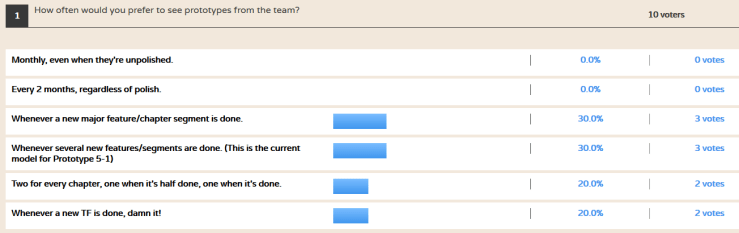
So it seems less frequent prototypes won the day here. We’ll probably stick along the current pattern of having several new features/areas completed between prototypes. Since nobody wanted fixed release schedules, it’s up to my discretion when to release stuff.

TeamQuestion1

This is where the polls aren’t too helpful, as the results are nicely split along less-testing, more-testing, and the current level. I’m still thinking I should allow myself a few extra days of testing before each release, because there’s some really humiliating bugs in these prototypes and I feel bad as a coder for letting anyone see that.

TeamQuestion2

Or: How to Read Statistics, With Salty. While it appears that “No, wait for the full release” won, it actually lost. The other 4 categories are all “Yes, after X time”, so 70% of the respondents think the prototype should go public at some point and are just divided on exactly when.

In this case, I’m thinking 1 month is about right. I won’t change the release schedule immediately, but once Prototype 5-2 comes out, the public will get access to it after 1 month.

TeamQuestion3

Congratulations, voters, because now I will probably alternate process videos in with concept art releases. It will likely be 2 concept arts for every 1 process video, assuming both are in equal quantity.

TeamQuestion4.png

Monday it is!

TeamQuestion5.png

So you want more transformations? Well you’re gonna get it! I’ve already taken this suggestion and modified one of the later sections of Chapter 5 accordingly.

TeamQuestion6

Interesting fact: People either prefer one of the group, or all of the group, but not two of any of the group.

And if you’re the person who said none of the above:
😦

Summary

So there’s the poll results. A lot of “keep doing what you’re doing”, some changes, and a lot of love for goats. As it should be. Now back to work.

Argue about this post on the forums.

Support the project on Patreon.

Design With a Grain of Salt: Enhanced Mode

Mockup

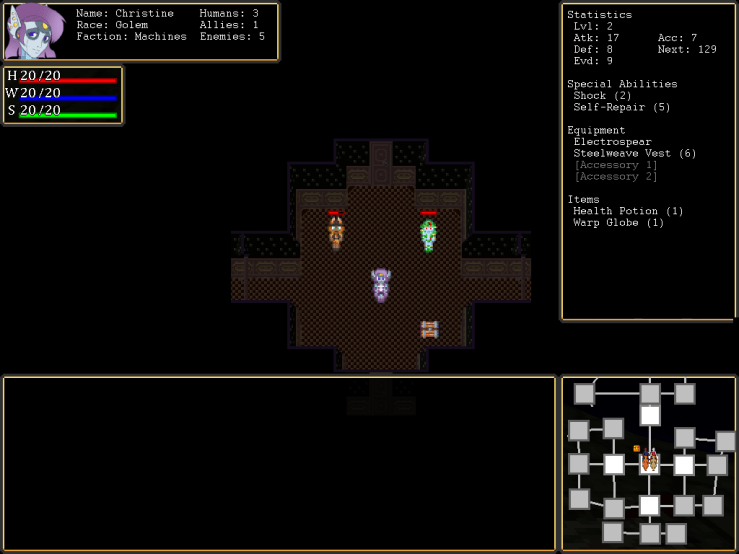
Yes, that’s right. Enhanced Mode. Check out this mockup I made. Yes I know the radar is totally wrong, it’s a mockup.

What is Enhanced Mode?

For those of you just joining us, Hop:Remastered originally started as a project to… remaster… House of Pandemonium. I think that’s obvious. But that job was completed after about 8 months of on-and-off work. Classic Mode is that, and it’s pretty close to the original but with more options and the bugs fixed.

Naturally, as soon as this job was complete, everyone wanted me to keep going. Add more features. Add new characters, new monsters, new stuff, new modes.

The scope got pretty big. There’s a lot I want to do with this, so much that it’d be so different from Classic Mode as to render them essentially different games. Hence, I started calling it Enhanced Mode.

Why are you making Adventure Mode first? Isn’t Enhanced Mode simpler?

Hey, this isn’t an FAQ.

But, yes, Enhanced Mode is simpler. But I want it to be more graphically interesting, and the creation of new characters and monsters requires art assets to match. So, the full development of Adventure Mode will also give me a full set of assets for Enhanced Mode, plus a much deeper lore and excuses to put in all kinds of extra features. Plus making Adventure Mode is a blast and so much fun you guys.

Let’s talk about the design choices.

Enhanced Mode is basically Classic Mode but with more monsters, features, ways to play, and other options. It is, in a word, enhanced.

When making such a thing, there are so many things you can do to improve the original that you essentially need to prioritize them. Identify what’s wrong with the previous version and fix it, and then add things to improve it. When doing this you must weigh them according to criteria. Here they are:

  1. Accessibility. The more complex a feature is, the harder it is for players to wrap their heads around it. Keep it simple, stupid.
  2. Cost to Benefit. The harder something is to implement, the more other stuff could get done instead. If something is really hard to code and has minimal payoff, skip it or redesign it.
  3. Asset Cost. Sprites are pretty and line-art is superb, but it costs artist time. Text is cheap but doesn’t look as nice. Combine the two with an eye towards using the player’s imagination, but never skimp on art. Just get the maximum possible use out of it. Don’t make a pretty portrait and then use it for one tiny thing most players won’t even find.
  4. Raw Fun. Once it’s in the game, test it. If it’s not fun (and you’re not making an art house game like Spec Ops or Papers Please), cut it or redesign it. Don’t put things in your game that aren’t fun.

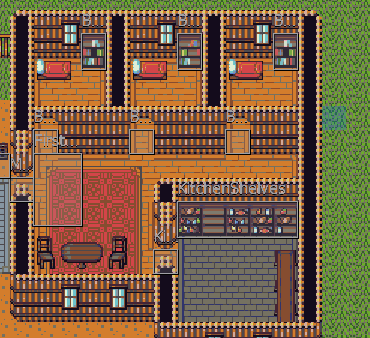
Good designers are constantly taking shortcuts and doing little redesigns to get the most out of their limited time and asset budget. If you’ve played Adventure Mode, have you ever noticed how all the furniture in the game is on the northern wall of the building?

PitStop

It’s not impossible to make furniture on the south wall, but then it’d be partially obscured by the high walls. This violates rules 1, 3, and 4 above. It’s more complex for the player for no real reason, it means I have to get my spriter to make twice as many tiles, and it certainly isn’t fun to guess if that’s a bookshelf or a foodshelf when I can’t see it because it’s facing the wrong way.

So with that, let’s take a look at some of my plans for Enhanced Mode.

Some of my plans for Enhanced Mode

Let’s start with the simpler stuff.

Armor, Weapons, Accessories

There’s a variety of new weapons available in the game with parallels from Adventure Mode. In the mockup, you can see that Christine is armed with an Electrospear, which is a powerful weapon that deals extra damage to robots and aquatic monsters.

Armor will also be in Enhanced Mode. Armor uses a degradation system. If you get hit while wearing armor, it takes the hit for you and loses HP. It breaks when its HP reaches 0. Some armor can be repaired, some regenerates HP over time, and some provides extra benefits like a defense bonus or speed bonus until it breaks.

You can also pick up accessories, like rings, amulets, and other bitties. These provide status boosts, with a chance to be cursed and have a malus or turn you into a Rusalka.

When playing as a monster, you can use weapons and armor. AI-controlled monsters typically spawn with theirs equipped already or use their bare hands and instead have higher stats. You can therefore help your allies by giving them your equipment if it’s better.

Levels and Statistics

That’s right, in Enhanced Mode, you can gain experience and level up. Your character gets stronger with each level, but groups of monsters can still take down a high-level character. The other humans on the field also level up, but the AI monsters don’t. It can therefore be a good idea to keep high-level humans… human. Because if they get transformed, they’re going to be very tough to take down.

Each of the six playable humans also has special abilities they learn as they level up. Each one thus plays differently. Sanya is very good at defeating high-health high-defense enemies with her powerful attacks, while Jeanne can learn to heal herself and summon weapons and armor for her teammates (and throw fireballs, but every mage does that).

Special Abilities

All monster forms come with special abilities, and there are more that can be learned in other ways. For example, all characters can learn magic spells if they find a scroll, though Jeanne’s are more powerful than the rest of the cast.

Special abilities usually cost Willpower or Stamina to use, though some are free. Most of them also have attached cooldowns where they cannot be used again for a few turns. Finally, some require combo-points which build up in combat and decay if there are no hostiles around for a few turns.

If you’re familiar with Adventure Mode, many of the special abilities are the same ones present there. Mei learns Rend to deal damage-over-time, while Alraunes can use Regrowth to recover their health.

Factionalism

Monsters are divided into a series of factions, based on their origins. These are (at present): Humans, Forest Creatures, Aquatic Creatures, Desert Creatures, Angels, Demons, Fey Creatures, Machines, Undead, and Eldritch Abominations.

The monsters are looking for recruits, and do not take kindly to other monster groups taking their catches. Different factions of monsters will fight amongst themselves for the human prizes, a fact which the humans can exploit. If you’re being pursued by some monsters, try fleeing towards other monsters of different factions.

Of course, when you become a monster you will be under similar pressures. They will attack you outright, sabotage your allies, and try to steal your equipment and human victims.

Each faction has several monsters that belong to it. For example, Alraunes, Slimes, Werecats, and Bees will work together as they are Forest Creature types.

Invasions and Bosses

Periodically, an ‘Invasion’ will be triggered. A portal will appear somewhere on the map and a group of monsters of the same faction will spawn out of it, along with a boss monster. The boss is a very tough monster, and is sometimes a named character from Adventure Mode. The portal will spawn reinforcements periodically as the monsters stream into the map, and the only way to shut the portal down is to deal with the boss monster guarding it. Of course, doing this will net you a lot of experience and possibly special items.

If you leave the portal too long, it will close on its own. This is bad, though, as the boss monster will then start wandering the mansion. Any allied monsters it finds will start to follow it in a retinue and they will probably curb-stomp anyone they find. Deal with the portal before this happens! Or, you know, don’t.

Faction Orders

You can set orders for your faction, which is very useful if you want everyone to group up. AIs of your faction will follow the set orders to the best of their ability. These orders include ordering your faction to group up with you, to spread out and search for targets, to stay together but periodically break off to look for loot (the AI will run to the group if they encounter a hostile), or to move to an exit point and leave the map.

Multiple Maps

Enhanced Mode has an option to allow you to leave the map and move to a new one. You cannot do this as a monster unless all humans have been cleared from the field. If you do this as a human, you will actually take control of another human on the field until they have all left the field for a new map. Most maps have one exit point, some have more.

Items spawn in logical places. You will often find armor and weapons in an armory, and potions in an alchemy lab. When playing with multiple maps, items will not respawn and instead will only spawn in new maps. Therefore, your team needs to move to new maps to keep finding new goodies. However, each time you leave the map, monsters will start spawning at higher levels. You’ll have to weigh the costs and benefits.

If you’re entering a new map as a monster, you will have to track down any escaped humans on the map. You may also keep a retinue of up to 3 other monsters with you as you go.

Victory Conditions

It’s now possible to actually win in Enhanced Mode! To do this, you must journey between several maps and locate six runestones. If you enter a map with a runestone, you will receive a notification and not be able to move to the next map without it.

The runestones have special properties attached to them, making them powerful items in their own right. They can also purify their associated human, turning them back into a human from a monster (each human has a color and symbol associated with them. Mei is grey, Sanya is red, Christine is violet, etc.). If you are on a map with a runestone but the bearer was transformed, they will spawn as a monster on that map and you’ll have to track them down once you find it. If the character gets transformed again, they will flee and you’ll have to find them, and their runestone, on a future map – assuming you make it that far.

If you become a monster, your goal is to track down and transform all remaining humans. After that, you ‘win’, and presumably go do monster things or open a pizza parlor or something.

That’s enough for now

I think I’ve rambled about Enhanced Mode enough for now.

I don’t intend to develop Enhanced Mode until we’re at least 2/3rds of the way through Adventure Mode, and it’ll be up to the Patrons to decide what my priorities are.

If you have good ideas for Enhanced Mode (that fit those four criteria above) and want to discuss it, we have a forum for that. Do that. I have a pretty long track record of implementing suggestions I get from patrons and forumgoers, so what have you got to lose?

Chapter 1 v1.04 Release and Poll Results!

Hey look, Chapter 1 v1.04 has been released! This version contains some fixes for longstanding annoying bugs, the much-requested compass functionality, new portraits for important characters and NPCs, a lo-res mode for older machines, and the ability to put notes on save files so you don’t forget which one is which.

You can download it here or go to the downloads page if you’re weird like that.

Mac Users: This is the first release I compiled on High Sierra. There may be bugs. In fact there probably are bugs. Let me know if you encounter any.

Screenshot 104

But wait, there’s more. Last week I asked the Patrons to vote on which optional content they wanted to see in the first prototype of Chapter 5.

Ch5SteeragePollImg0

So it looks like Equinox Labs will be going into the prototype, and if we have spare time, Serenity Crater Observatory. As a development update, I’ve finished the scenario work for Regulus City (polish and editing are still needed) and will be starting on the Long Range Telemetry facility next. I just need some tiles from Urimas first.

Ch5SteeragePollImg1.png

These questions were meant as a rough gauge of interest in each of the optional areas. I provided spoiler-free area descriptions with the bare-minimum detail necessary, and somehow managed to net at least a 6 for all areas. That makes me feel pretty good.

We also got one long-form series of questions from a respondent who shall remain anonymous. The questions are listed here:

Is there a partner [in Chapter 5] like in Chapter 1?

Yes. Chapter 1 and Chapter 5 are the only chapters which have one teammate. Chapters 2, 3, and 4 actually have two partners.

Do any of these quests relate to them?

Without spoiling anything, half of the quests relate a great deal to Christine’s partner. All of them relate to Christine’s themes.

I enjoyed the pie quest because it meant more time chilling with Breanne, I enjoyed the bee quest because it meant helping out the bees and getting a better idea of what was happening the forest, I enjoyed the cultist dungeon because it involved working with the Alraunes and putting the beat down on the cultists.

You’re going to love Regulus City.

The quests as presented don’t tell me much about the characters involved, or what will happen to our main character.

Just because I want to keep it spoiler-free. There are twists and turns, and things will happen that you certainly didn’t expect unless you hacked the game files.

So that’s it for this update. We’re making good progress on Chapter 5 and I definitely think we’ll make the end-of-March time frame. Chapter 5 will likely be finished sometime in the summer at this rate, possibly earlier. Get psyched!